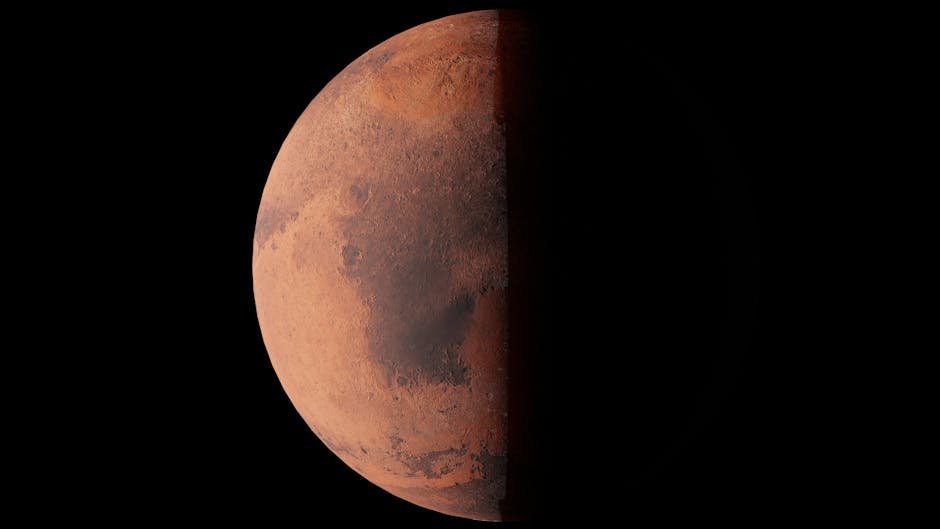
NASA's Psyche Captures Haunting Mars Crescent Before May 15 Flyby
NASA's Psyche spacecraft recently captured a unique and "haunting" crescent view of Mars, offering a rare perspective of the Red Planet. This striking image was taken as the robotic explorer approached for a crucial gravity-assist flyby scheduled for May 15, an essential maneuver on its deep-space journey towards a metal-rich asteroid.
The successful flyby and the preceding imagery underscore the precision and complexity of interplanetary missions, marking a significant milestone for the Psyche mission as it continues its six-year voyage through the solar system.
Background: Charting a Course to a Metal World
The Psyche mission represents a pioneering endeavor in planetary science, with its primary objective being the study of the asteroid Psyche. This celestial body, located in the main asteroid belt between Mars and Jupiter, is unlike most asteroids observed to date, which are typically rocky or icy. Scientists believe Psyche could be the exposed nickel-iron core of an early protoplanet that lost its outer layers during violent collisions billions of years ago.
The Mission’s Genesis and Scientific Goals
Conceived as part of NASA’s Discovery Program, the Psyche mission aims to answer fundamental questions about planetary formation, particularly how terrestrial planets like Earth separated into metallic cores and rocky mantles. By directly observing a potential planetary core, scientists hope to gain unprecedented insights into the early solar system’s processes, which are otherwise inaccessible.
The mission is led by Arizona State University (ASU) and managed by NASA’s Jet Propulsion Laboratory (JPL) in Southern California. The scientific payload includes a multispectral imager, a gamma-ray and neutron spectrometer, and a magnetometer, all designed to characterize the asteroid’s composition, topography, and magnetic properties.
Launch and Initial Trajectory
The Psyche spacecraft launched on October 13, 2023, aboard a SpaceX Falcon Heavy rocket from Launch Complex 39A at NASA’s Kennedy Space Center in Florida. The powerful launch vehicle was necessary to propel the 2,600-kilogram (5,700-pound) probe out of Earth’s gravitational pull and set it on its initial trajectory towards the outer solar system.
Following launch, the spacecraft deployed its solar arrays and began its cruise phase, relying on solar electric propulsion, specifically Hall-effect thrusters that use xenon gas. This efficient propulsion system will gradually accelerate the spacecraft over its long journey, conserving fuel for critical maneuvers.
The Role of Gravity Assists
Interplanetary missions often utilize gravity-assist maneuvers, also known as “slingshots,” to gain speed and alter their trajectory without expending significant amounts of onboard propellant. These maneuvers involve flying close to a planet, using its gravitational pull to accelerate the spacecraft and redirect its path.
For the Psyche mission, the May 15 flyby of Mars is the only planetary gravity assist planned. This crucial encounter will provide the necessary boost to send the spacecraft further out into the asteroid belt, adjusting its velocity and direction to precisely intercept the asteroid Psyche in 2029.
Key Developments: The Martian Encounter
The recent images and the impending flyby represent a critical phase in the Psyche mission's journey. Capturing the "haunting crescent" view of Mars was not only a visually stunning achievement but also served practical purposes for the mission team.
The Haunting Crescent Image
Days before its closest approach, Psyche’s multispectral imager captured a unique perspective of Mars. The image depicted the Red Planet as a thin crescent, illuminated by the distant Sun, with much of its surface cloaked in shadow. This view is characteristic of a distant observer looking towards the Sun, similar to how Earth might appear from Mars during certain orbital alignments.
The image offers a stark, almost ethereal quality, contributing to its “haunting” description. From a scientific standpoint, such imagery allows mission engineers to calibrate the spacecraft’s instruments in real-time, ensuring they are functioning optimally for the primary science phase at the asteroid Psyche. It also provides an opportunity to test imaging sequences and data transmission protocols.
The May 15 Gravity Assist Flyby
On May 15, the Psyche spacecraft executed its gravity-assist maneuver, passing within approximately 60,000 kilometers (37,000 miles) of Mars. This close approach allowed Mars’s gravity to bend the spacecraft’s trajectory, increasing its speed by thousands of kilometers per hour and altering its course towards the asteroid belt.
The flyby required meticulous planning and precise navigation. Mission controllers at JPL continuously tracked the spacecraft, making minor trajectory correction maneuvers to ensure the optimal approach. The success of this maneuver is vital, as any significant deviation could add years to the journey or necessitate substantial propellant use to correct the course.
Spacecraft Health and Performance
Throughout its cruise phase, the Psyche spacecraft has demonstrated excellent health and performance. Its solar electric propulsion system, a key technology for deep-space missions, has been operating efficiently, steadily accelerating the probe. The spacecraft’s communication systems, relying on NASA’s Deep Space Network (DSN), have maintained robust links with Earth, enabling the transmission of telemetry data and the stunning Mars imagery.
A notable technological experiment aboard Psyche is the Deep Space Optical Communications (DSOC) system. This cutting-edge technology aims to transmit data using lasers, promising significantly higher bandwidths than traditional radio frequency systems. DSOC has already achieved several milestones, including the first successful transmission of data from deep space, paving the way for future high-data-rate missions.
Impact: Unlocking Solar System Secrets
The Psyche mission, with its unique target and advanced technologies, carries profound implications for the scientific community, NASA, and the broader public.
Revolutionizing Planetary Science
The primary impact of the Psyche mission lies in its potential to transform our understanding of planetary formation. If asteroid Psyche is indeed an exposed protoplanetary core, its study will offer the first direct observations of such a structure. This will provide invaluable data to test and refine models of how rocky planets, including Earth, differentiated into distinct layers of core, mantle, and crust.
Scientists are particularly interested in Psyche’s magnetic properties. If it retains a remnant magnetic field, it could indicate that the protoplanet from which it originated once had an active dynamo, similar to Earth’s core. This would offer clues about the conditions and processes that generate planetary magnetic fields, which are crucial for protecting atmospheres from solar wind.
Advancing Space Exploration Capabilities
The mission serves as a testbed for several critical technologies. The successful deployment and operation of the solar electric propulsion system demonstrate its reliability for long-duration, fuel-efficient deep-space travel. This technology is vital for future missions to the outer planets and beyond, where conventional chemical propulsion would be prohibitively expensive or complex.
Furthermore, the Deep Space Optical Communications experiment is a game-changer. Higher data rates mean more scientific data can be returned from distant probes, enabling more ambitious and detailed investigations. This technology is essential for future human missions to Mars and beyond, where real-time, high-bandwidth communication will be paramount.
Inspiring the Next Generation
Beyond scientific and technological advancements, the Psyche mission plays a crucial role in public engagement and education. The captivating images, like the crescent Mars view, capture the imagination and inspire interest in space exploration, science, technology, engineering, and mathematics (STEM) fields. Such missions demonstrate humanity’s capacity for innovation and discovery, encouraging future generations to pursue careers in these vital areas.
The narrative of exploring a metal world, a potential building block of planets, resonates with a universal curiosity about our origins and place in the cosmos. It highlights the ongoing quest to understand the universe around us.
What Next: The Road to Asteroid Psyche
With the Mars gravity assist successfully completed, the Psyche spacecraft now enters the longest phase of its journey: the deep-space cruise towards its namesake asteroid. This period will involve continuous monitoring, occasional trajectory corrections, and ongoing instrument calibration.
Cruise Phase and Final Approach
The spacecraft will continue to use its solar electric propulsion system to gradually accelerate and adjust its trajectory. Mission controllers will regularly communicate with Psyche via the Deep Space Network to monitor its health, download engineering data, and upload new commands. The DSOC experiment will also continue its testing, pushing the boundaries of deep-space communication.
The Psyche spacecraft is expected to reach the asteroid Psyche in August 2029. Upon arrival, it will execute a series of orbital insertion maneuvers to enter a stable orbit around the asteroid. This will be a complex sequence of thruster firings, carefully planned to account for the asteroid’s relatively small gravitational pull.
Orbital Operations and Scientific Observations
Once in orbit, the mission will begin its primary science phase, which is expected to last approximately 21 months. The spacecraft will gradually descend through a series of orbits, moving closer to the asteroid to gather increasingly detailed data.
Multispectral Imager
The imager will capture high-resolution images of Psyche's surface, mapping its topography, identifying surface features, and looking for evidence of different material compositions. This will help scientists understand the asteroid's geological history and how its surface has evolved.
Gamma-Ray and Neutron Spectrometer (GRNS)
The GRNS will detect and measure the elemental composition of Psyche's surface. By analyzing the gamma rays and neutrons emitted from the asteroid, scientists can determine the abundance of elements like iron, nickel, silicon, and other metals, providing direct evidence for its metallic nature.
Magnetometer
The magnetometer will search for any remnant magnetic field on Psyche. The presence of a magnetic field would be a strong indicator that the asteroid was once part of a larger, differentiated body that had a molten, convecting core capable of generating a dynamo.
Radio Science
By precisely tracking the spacecraft's orbit around Psyche, scientists can use radio science to map the asteroid's gravity field. This data will reveal the distribution of mass within Psyche, providing insights into its internal structure and density variations.
Long-Term Legacy and Future Prospects
The data collected by the Psyche mission will be meticulously analyzed by scientists worldwide, contributing to a deeper understanding of our solar system’s origins. The mission’s success could pave the way for future exploration of other metallic asteroids, potentially informing discussions about space resource utilization, though Psyche’s primary goal remains pure scientific discovery.
Ultimately, the Psyche mission is a testament to human ingenuity and our insatiable drive to explore. From a haunting crescent view of Mars to the eventual rendezvous with a mysterious metal world, this journey promises to unlock profound secrets about the formation of planets and the very building blocks of our cosmic neighborhood.