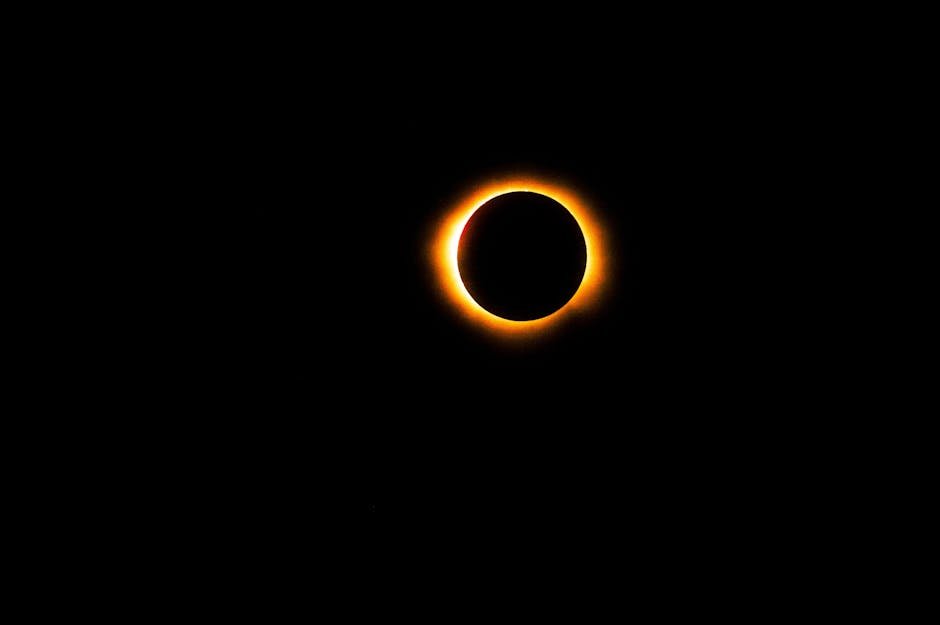
Scientists have identified significant, localized increases in mesospheric ozone during solar eclipses. This phenomenon occurs in the mesosphere, an atmospheric layer between 50 and 85 kilometers altitude. Recent sensitivity experiments using the Whole Atmosphere Community Climate Model with thermosphere and ionosphere extension (WACCM-X) have shed light on the mechanisms behind these "tertiary-ozone-maximum-like" enhancements.
Background: Unveiling the Mesosphere’s Secrets
Ozone, a molecule composed of three oxygen atoms (O3), plays a critical role in Earth's atmosphere. In the stratosphere, approximately 15 to 35 kilometers above the surface, it forms a protective layer that absorbs harmful ultraviolet (UV) radiation from the sun, safeguarding life on Earth. However, ozone also exists in other atmospheric layers, each with distinct chemical environments and varying concentrations.
The mesosphere, situated above the stratosphere and below the thermosphere, is Earth's coldest atmospheric layer, with temperatures plummeting to below -100 degrees Celsius. It is a region of incredibly low atmospheric density, making it challenging to study directly. Despite its thinness, the mesosphere is crucial for understanding atmospheric dynamics, energy transfer, and the chemistry of minor constituents, including ozone.
Unlike the stratospheric ozone layer, where ozone is primarily formed and destroyed by interactions with UV radiation and chlorine compounds, mesospheric ozone chemistry is dominated by odd hydrogen (HOx) radicals. These highly reactive species, which include hydrogen atoms (H), hydroxyl radicals (OH), and hydroperoxyl radicals (HO2), are primarily formed when solar UV radiation breaks apart water vapor (H2O) and methane (CH4) molecules. HOx radicals act as efficient catalysts for the destruction of ozone in the mesosphere, maintaining a delicate balance.
Solar eclipses offer unique "natural experiments" for atmospheric scientists. As the moon temporarily blocks the sun's light, there is a sudden and dramatic reduction in incoming solar radiation, particularly UV wavelengths. This abrupt change provides an opportunity to observe how the atmosphere responds to a rapid alteration of its primary energy source. While previous studies have examined stratospheric and ionospheric responses to eclipses, the specific, transient behavior of mesospheric ozone has remained less thoroughly explored.
Atmospheric models are indispensable tools for investigating these complex interactions. WACCM-X is one of the most sophisticated global climate models available, extending from Earth's surface all the way up to the thermosphere, approximately 500 kilometers altitude. Its comprehensive representation of atmospheric chemistry, dynamics, and radiation allows researchers to simulate the intricate coupling between different atmospheric layers and predict their responses to various stimuli, including solar eclipses. The model's ability to resolve detailed chemical kinetics, particularly in the mesosphere, makes it ideal for probing the subtle shifts in ozone concentrations.
The term "tertiary ozone maximum" refers to a distinct peak in ozone concentration that can occur at very high altitudes, separate from the well-known stratospheric maximum (the primary peak) and sometimes a secondary peak in the upper stratosphere/lower mesosphere. The identification of an "eclipse-driven tertiary-ozone-maximum-like" increase suggests a temporary, localized enhancement of ozone in the upper mesosphere, a region where its behavior is particularly sensitive to solar radiation.
Key Developments: WACCM-X Reveals Eclipse-Driven Ozone Surge
Recent sensitivity experiments conducted using the WACCM-X model have provided unprecedented insights into the mesospheric ozone response during solar eclipses. The research team configured the model to simulate various eclipse scenarios, varying parameters such as the duration of totality, the maximum obscuration percentage, the solar zenith angle, and the background atmospheric conditions. This allowed for a comprehensive analysis of the factors influencing the mesospheric chemical balance.
The most significant finding from these WACCM-X experiments was the consistent identification of a pronounced, albeit temporary, increase in ozone concentrations within the upper mesosphere. This "tertiary-ozone-maximum-like" enhancement was observed predominantly in an altitude range spanning approximately 60 to 75 kilometers above Earth's surface. Model simulations indicated that ozone levels in this specific region could surge by as much as 30-50% above ambient, non-eclipse conditions during the peak of the solar obscuration. These elevated ozone levels typically persisted for several hours after the eclipse's maximum, gradually returning to normal as solar radiation was fully restored.
The underlying mechanism for this mesospheric ozone surge was meticulously dissected by the WACCM-X model. The primary driver identified was a rapid and significant reduction in the production of odd hydrogen (HOx) radicals. During an eclipse, the sudden dimming of the sun, particularly the shortwave UV radiation, directly impacts the photolysis rates of water vapor (H2O) and methane (CH4). These molecules are the main precursors to HOx radicals in the mesosphere. With less UV radiation available, fewer H2O and CH4 molecules are broken down, leading to a sharp decline in the formation of H, OH, and HO2.
In the mesosphere, HOx radicals are the dominant agents for ozone destruction. They rapidly catalyze the conversion of ozone back into molecular oxygen (O2). When the production of these ozone-destroying radicals diminishes significantly during an eclipse, the rate of ozone destruction slows dramatically. While ozone production also decreases due to reduced UV, the model clearly showed that the *reduction in destruction* outpaced the *reduction in production*. This imbalance results in a net accumulation of ozone, leading to the observed increase.
Sensitivity tests within the WACCM-X framework further illuminated the phenomenon:
Eclipse Totality and Duration: The magnitude and duration of the mesospheric ozone increase were directly correlated with the totality and duration of the eclipse. Longer periods of complete or near-complete solar obscuration resulted in more substantial ozone enhancements and a slower return to baseline levels. A total solar eclipse, by blocking nearly all direct solar radiation, produced the most pronounced effects.
* Solar Zenith Angle: The impact was also sensitive to the solar zenith angle, meaning the angle at which the sun's rays hit the atmosphere. Eclipses occurring at lower solar zenith angles (i.e., closer to midday) produced stronger responses due to the higher ambient UV flux and thus a greater absolute reduction in photolysis rates.
* Background Atmospheric Conditions: The model explored the influence of initial atmospheric states, such as variations in stratospheric ozone levels, mesospheric water vapor content, and ambient temperatures. While the fundamental mechanism remained consistent, subtle differences in these background conditions could modulate the exact timing and magnitude of the ozone response. For instance, higher initial water vapor content could lead to a more pronounced HOx reduction and thus a stronger ozone increase.
* Wavelength Specificity: WACCM-X simulations indicated that specific bands of UV radiation, particularly those responsible for the photolysis of H2O and O2, were most critical in driving the mesospheric ozone response. The sudden removal of these specific wavelengths during an eclipse was the key trigger for the HOx reduction.
Beyond chemical changes, the WACCM-X experiments also investigated potential dynamical contributions. While temperature changes and altered atmospheric transport can occur during eclipses, the model showed that the chemical effects, particularly the HOx-ozone interaction, were overwhelmingly dominant in explaining the observed mesospheric ozone increases. This clarifies that the phenomenon is primarily a photochemical response to the abrupt change in solar radiation.
Impact: Refining Our Atmospheric Understanding
The findings from these WACCM-X sensitivity experiments have several significant implications for atmospheric science. Primarily, they provide a refined and more detailed understanding of mesospheric chemistry, particularly how this upper atmospheric layer responds to sudden and dramatic changes in solar radiation. The intricate balance between ozone production and destruction, heavily influenced by HOx radicals, is now better characterized under transient conditions.
This research significantly contributes to the validation and improvement of sophisticated atmospheric models like WACCM-X. By accurately simulating the observed "tertiary-ozone-maximum-like" increases, the study reinforces the reliability of the chemical schemes and physical parameterizations embedded within these models. This enhanced confidence means that WACCM-X and similar models can be more accurately applied to predict atmospheric behavior under a wider range of conditions, including those influenced by solar variability or other transient events.
For climate science, understanding such rapid and localized atmospheric responses is crucial for developing a holistic view of Earth's climate system. While a mesospheric ozone surge during an eclipse is a temporary and localized phenomenon, it sheds light on the fundamental processes governing atmospheric composition. The mesosphere is a region where coupling between different atmospheric layers occurs, and a detailed understanding of its chemistry helps piece together the complex interactions that shape our planet's atmosphere, particularly in the context of ongoing climate change which can affect stratospheric and mesospheric composition.
The study further reinforces the invaluable role of solar eclipses as unique natural laboratories. These events provide unparalleled opportunities to observe atmospheric phenomena that cannot be replicated in controlled laboratory settings or through standard observational campaigns. By acting as a global-scale "switch" for solar radiation, eclipses allow scientists to isolate and study the atmospheric response to sudden changes, testing theoretical models and advancing our understanding of fundamental atmospheric processes.
Moreover, while the mesosphere is not directly involved in terrestrial weather, it serves as a transition region to the ionosphere, which is directly affected by space weather events. Changes in mesospheric chemistry and composition, even transient ones, can have subtle ripple effects on the layers above, influencing ionospheric dynamics and potentially impacting radio communications and satellite operations. Understanding these lower-layer responses contributes to a more complete picture of the Earth-space environment.
What Next: Future Research and Observational Campaigns
The compelling results from the WACCM-X sensitivity experiments pave the way for exciting future research and observational endeavors. A critical next step involves dedicated observational campaigns during upcoming total and annular solar eclipses. For instance, the total solar eclipse traversing North America in April 2024 presents an unparalleled opportunity to gather direct measurements of mesospheric ozone and related species.

These campaigns should utilize a combination of advanced instrumentation. Ground-based lidars, capable of remotely sensing ozone profiles, could be deployed along the eclipse path. Sounding rockets, launched during the eclipse, could carry instruments designed to measure in-situ concentrations of ozone, water vapor, and crucially, HOx radicals in the mesosphere. Satellite instruments, with their global coverage, could provide broader context and track the spatial and temporal evolution of the ozone enhancements. Direct observational validation of the WACCM-X predictions would significantly strengthen the scientific community's understanding of this phenomenon.
From a modeling perspective, further refinements to WACCM-X and other comprehensive atmospheric models are anticipated. This could involve incorporating even more detailed chemical kinetics, exploring a broader range of initial atmospheric conditions, or investigating the influence of solar flares or other space weather events in conjunction with eclipses. Researchers could also use the refined model to explore other atmospheric responses during eclipses, such as changes in other trace gases like nitric oxide or variations in mesospheric temperature and dynamics.
Beyond immediate eclipse studies, the insights gained from this research can be applied to broader questions in atmospheric science. How do these transient mesospheric changes affect atmospheric waves, such as gravity waves, that propagate through the atmosphere? Do these localized ozone surges have any long-term or cumulative effects on atmospheric circulation patterns?
Ultimately, the continued progress in understanding eclipse-driven mesospheric ozone increases will depend on robust collaboration between atmospheric modelers and experimentalists. The synergy between theoretical predictions from models like WACCM-X and empirical data from observational campaigns will be essential for fully unraveling the complex and dynamic chemistry of Earth's middle atmosphere.